
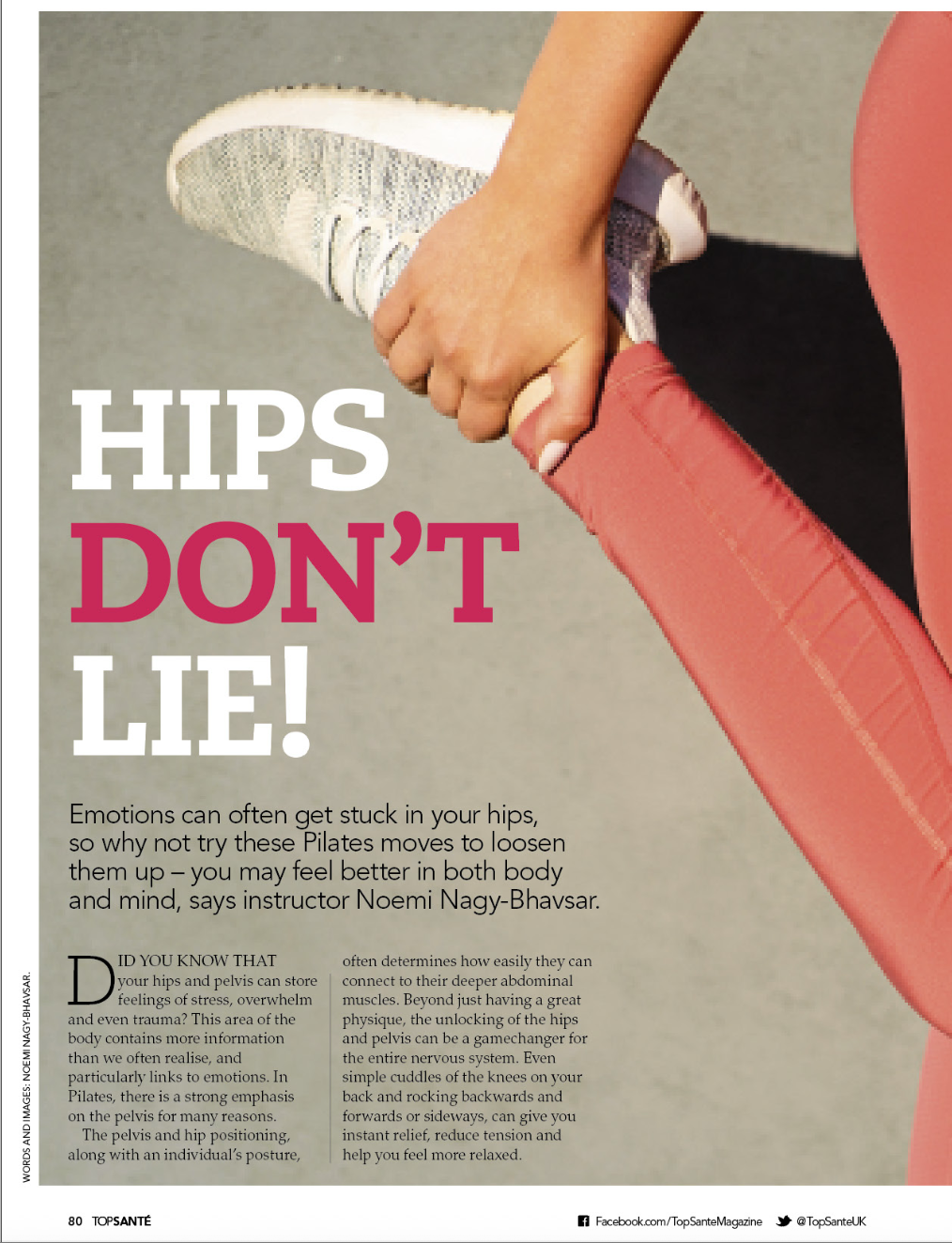
Hips Don't Lie: Pilates Moves to Release Tension and Free Your Hips
This feature was published in Top Santé magazine in April 2026, as part of my ongoing work as a Pilates instructor and movement specialist.
The hips hold more than most people realise. In Pilates, we talk about the pelvis as the centre of everything — posture, movement, core connection — but it is also an area where the body stores stress, tension and even emotion. If your hips feel tight, restricted or uneven, it is rarely just a physical problem.
Daily habits make this worse. Sitting for long periods, carrying a bag on one shoulder, hunching over a phone — all of these gradually pull the pelvis out of alignment. You may not notice it at first, but over time it shows up as lower back discomfort, restricted movement, or a sense that one side of your body works harder than the other.
The Pilates work I focus on in this feature is about two things: releasing what is held, and rebuilding control. The exercises target the hips and pelvis specifically, using oppositional stretching and strengthening to restore balance. They are accessible enough to do at home, but precise enough to make a real difference if you do them with attention.
The five moves include a high kneeling hip opener, hip hinge, side-lying clam, hip twist with a spikey ball, and leg circles. Start gently, notice which side feels more restricted, and work with that information rather than pushing through it.
The full feature is published in Top Santé magazine.
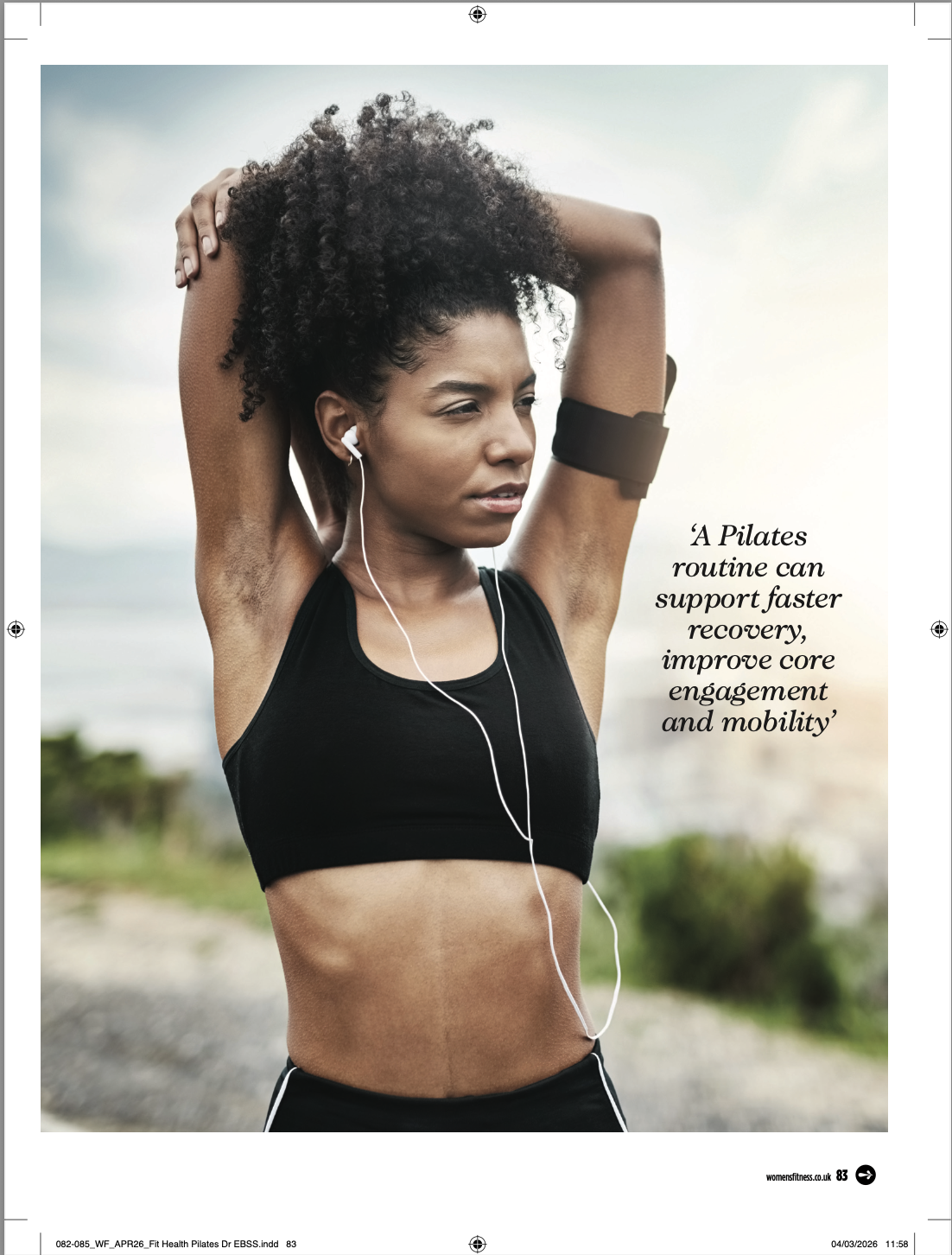
The Pilates Advantage: How Pilates Supports Runners
This column was published in the April 2026 issue of Women's Fitness, as part of my regular Pilates Doctor feature.
Running is one of the most accessible and beneficial forms of exercise — but because it is repetitive and one-directional, it creates imbalances. The same muscles get loaded, the same joints take the strain, and over time that pattern leads to injury.
This is where Pilates earns its place in a runner's training plan. It is not about adding more intensity — it is about addressing what running misses. Foot and ankle stability, hip strength, spinal mobility, pelvic control. These are the foundations that determine whether you run efficiently or whether you compensate, overload and eventually break down.
In this feature I focus on when and how to bring Pilates into your running routine: as a warm-up, a cool-down, and as active recovery between runs. The four moves I share work across all three planes of motion — forwards and back, side to side, and rotational — because your body needs all three to move well, not just the sagittal plane that running dominates.
If you are dealing with a recurring injury, weak ankles, or just a sense that something is slightly off in how you move, these exercises are a good place to start. The goal is a body that is stronger, steadier and more resilient — not just faster.
The full feature is published in Women's Fitness, April 2026.
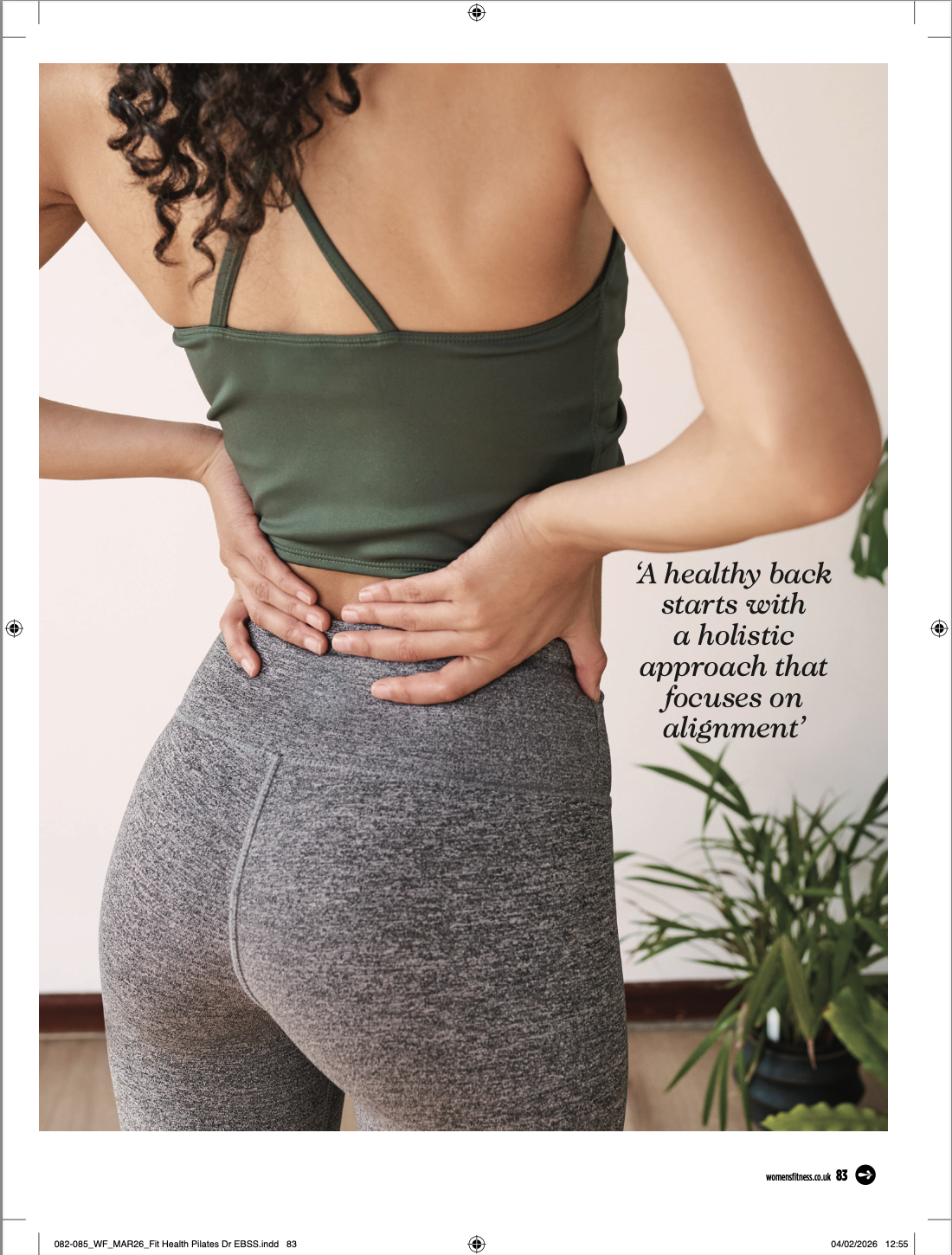
From Women’s Fitness March 2026
This column was published in the March 2026 issue of Women's Fitness, as part of my regular Pilates Doctor feature.
Back pain is one of the most common reasons people come to me at Beyond Move — and one of the most misunderstood. The instinct is often to rest, or to avoid movement altogether. But in most cases, the opposite is true. A healthy back needs to move, and it needs to be supported by the muscles around it working properly.
What I focus on in this feature is not just strengthening the back in isolation, but addressing the whole system: alignment, core engagement, spinal mobility and the smaller stabilising muscles that most people never train. These are the muscles that do the quiet, essential work of keeping you upright, balanced and pain-free over time.
The five exercises I share — breaststroke, modified side plank, hip twist with weights, oblique abdominal prep with a ball, and diamond press-ups — can be done three to five times a week. They work across the posterior chain, the obliques, the lumbo-pelvic area and the upper back. Done with attention to form, you should start to feel a difference within five to six days.
As with all Pilates work: do not push through pain, start with fewer reps and build gradually, and always consult your GP or physiotherapist if you have an existing condition.
The full feature is published in Women's Fitness, March 2026.