
What is Petö Pilates? How It Supports Neurological Conditions and Transforms Movement
This feature was published in the November 2025 issue of Women's Fitness.
Most people come to Pilates for core strength or back pain. What fewer people know is that Pilates — done in the right way, by the right teacher — can be genuinely transformative for people living with neurological conditions. This is the work I am most proud of at Beyond Move, and it is the reason I trained at the International Petö Institute.
Petö Pilates bridges general Pilates and specialist neurological rehabilitation. It draws on Conductive Education — a Hungarian method developed by András Petö — which teaches the brain and body to work together more effectively through small, deliberate, achievable movement. The approach is built on a simple but powerful principle: that the brain can form new pathways, and that movement is one of the most effective ways to support that process.
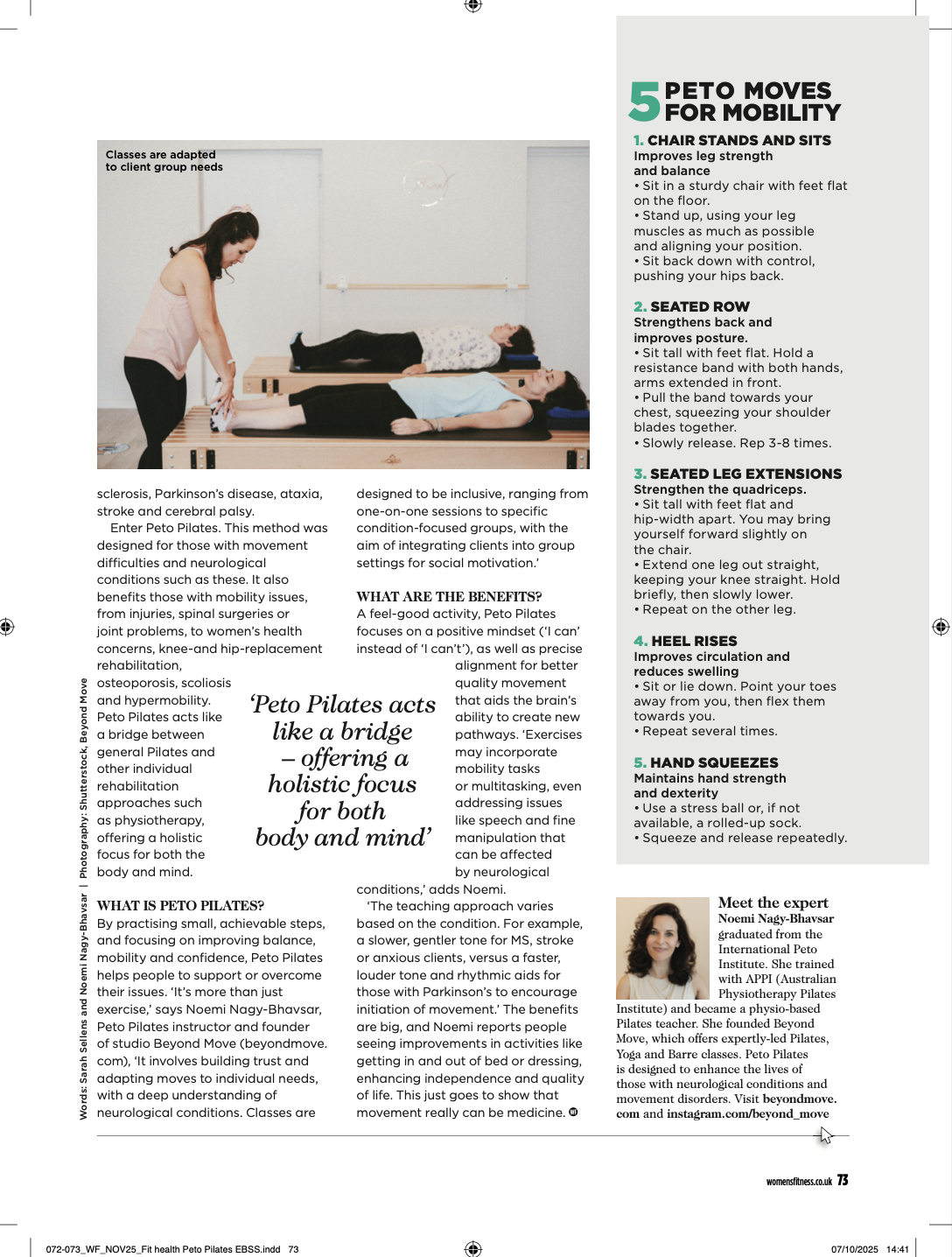
At Beyond Move, I work with clients living with Parkinson's disease, multiple sclerosis, stroke, cerebral palsy, ataxia and other neurological conditions. Each session is adapted to the individual — their condition, their energy levels, their goals. For someone with Parkinson's, that might mean a faster pace and rhythmic cues to encourage movement initiation. For someone with MS or anxiety, a slower, gentler approach. The exercises themselves may be small — chair stands, seated rows, heel rises — but the cumulative effect on independence, confidence and quality of life can be significant.
This is not exercise for exercise's sake. It is movement as medicine.
The five Petö moves in this feature are accessible to most people regardless of ability level. They can be done seated, require no specialist equipment, and focus on the areas that matter most for daily function: leg strength, posture, circulation and hand dexterity. If you or someone you know is living with a neurological condition and wondering whether Pilates could help, this is a good place to start.
The full feature is published in Women's Fitness, November 2025.


